When Does Etihad Rail Passenger Service Start?
Passenger rail in the UAE launches in stages, not all at once. Here is the confirmed rollout, station by station, as announced by Etihad Rail:
30 June 2026: Introductory operational phase begins, connecting Abu Dhabi's Mohamed bin Zayed City Passenger Train Station to Al Hilal City station in Fujairah. This is the only route available at launch.
30 September 2026: The network's official launch date. Dubai's Al Yalayis Train Station (near Jumeirah Golf Estates) and Al Dhaid Train Station (Sharjah) open, extending the network westward and adding Sharjah's inland corridor.
30 November 2026: Madinat Zayed and Liwa (Mezaira'a) stations open, the first two in Abu Dhabi's Al Dhafra region.
30 December 2026: Al Sila, Al Dhannah and Al Mirfa stations open, completing the Al Dhafra coast.
30 March 2027: Sharjah's University City station opens, completing the initial passenger rail route across the UAE.
By the time this rollout finishes in March 2027, the network will connect 11 confirmed stations from Al Sila in the west to Fujairah in the east, with annual ridership projected to exceed 36.5 million passengers.
Etihad Rail Stations: Complete List
| Station | Emirate / Region | Opening Date |
|---|
| Mohamed bin Zayed City | Abu Dhabi | 30 June 2026 |
| Al Hilal City (Fujairah) | Fujairah | 30 June 2026 |
| Al Yalayis (Dubai, near Jumeirah Golf Estates) | Dubai | 30 September 2026 |
| Al Dhaid | Sharjah | 30 September 2026 |
| Al Sila | Abu Dhabi (Al Dhafra) | 30 December 2026 |
| Al Dhannah | Abu Dhabi (Al Dhafra) | 30 December 2026 |
| Al Mirfa | Abu Dhabi (Al Dhafra) | 30 December 2026 |
| Madinat Zayed | Abu Dhabi (Al Dhafra) | 30 November 2026 |
| Liwa / Mezaira'a | Abu Dhabi (Al Dhafra) | 30 November 2026 |
| University City | Sharjah | 30 March 2027 |
The two stations open right now, at launch, are Mohamed bin Zayed City in Abu Dhabi and Al Hilal City in Fujairah. Every other station on this list is announced and dated but not yet operational.
About the First Stations
Mohamed bin Zayed City Passenger Train Station was formally inaugurated by Sheikh Khaled bin Mohamed bin Zayed Al Nahyan, Crown Prince of Abu Dhabi, ahead of the June 30 launch. Etihad Rail has confirmed a shuttle bus service connecting the station to key locations across the capital, including ADNOC headquarters on Corniche Road West, the ADNEC Centre on Al Khaleej Al Arabi Street, and Reem Mall on Al Reem Island.
Al Hilal City Station, Fujairah was the first passenger station to be fully completed. It sits 12 minutes by car from Fujairah International Airport, five minutes from Sakamkam Fort, and six minutes from Umbrella Beach. A large area of land surrounding the station is expected to develop into a major new residential district over time, similar to how station-area development has historically reshaped property markets near transit hubs elsewhere.
Get the Best Offer: Property For Sale in Abu Dhabi
Journey Times Between Cities
| Route | Journey Time |
|---|
| Abu Dhabi to Fujairah | 1 hour 45 minutes |
| Abu Dhabi to Dubai | Approximately 57 minutes |
| Dubai to Fujairah | Approximately 69 minutes |
| Abu Dhabi to Al Ruwais | Approximately 70 minutes |
These are the journey times Etihad Rail has published for its standard passenger network. The Abu Dhabi-Fujairah route is the only one currently operating; the Abu Dhabi-Dubai and Dubai-Fujairah times will apply once Dubai's station opens in September 2026.
The Future High-Speed Line
In a separate and much faster development, Etihad Rail announced in 2025 a dedicated high-speed line between Abu Dhabi and Dubai, a 150-kilometre track designed to run at speeds of up to 350 km/h, cutting the journey between the two cities to just 30 minutes. This high-speed line is expected to be operational by 2030 and is distinct from the standard passenger network described above, which will continue running at up to 200 km/h.
Three trains run in each direction every day between Abu Dhabi (Mohamed bin Zayed City) and Fujairah (Al Hilal City). This is the current Etihad Rail timetable for the Abu Dhabi to Fujairah route:
| Direction | Departs | Arrives |
|---|
| Abu Dhabi to Fujairah | 8:19 am | 10:04 am |
| Abu Dhabi to Fujairah | 1:53 pm | 3:38 pm |
| Abu Dhabi to Fujairah | 6:39 pm | 8:24 pm |
| Fujairah to Abu Dhabi | 5:34 am | 7:19 am |
| Fujairah to Abu Dhabi | 10:59 am | 12:44 pm |
| Fujairah to Abu Dhabi | 5:28 pm | 7:13 pm |
Every journey takes 1 hour 45 minutes. Etihad Rail asks passengers to arrive at the station at least 20 minutes before departure with their ticket and ID ready. The timetable will change on 30 September 2026 when the Dubai and Al Dhaid stations join the route, so check etihadrail.ae or the Etihad Rail app for the timings on your travel date.
Etihad Rail Ticket Prices, Fares and How to Book
Ticket Prices (Abu Dhabi to Fujairah)
Etihad Rail launched with a 50 percent discount on the regular fare. The launch prices below apply while the promotional period runs; the regular fares are what the operator has published for after it ends.
| Ticket | Comfort Class | Premium Class |
|---|
| Adult, Saver (launch fare) | AED 55 | AED 120 |
| Adult, Value (seat selection, changes up to 72 hours before departure) | AED 65 | AED 130 |
| Adult, Flex (changes until 30 minutes before, full refund if cancelled 24 hours ahead) | AED 75 | AED 160 |
| Child, 2 to 17 years | AED 28 | AED 60 |
| Senior, 60 and over | AED 44 | AED 96 |
| Infant under 2 on an adult's lap | Free | Free |
| Regular adult fare after the launch offer | AED 109 | AED 239 |
Both classes include a guaranteed seat and onboard Wi-Fi. Fares for the Dubai and Sharjah stations have not been announced yet and will be published by Etihad Rail before those stations open on 30 September 2026.
How to Book
Tickets became available for booking from 23 June 2026, ahead of the 30 June launch, through three channels:
Official website: book directly at etihadrail.ae, selecting departure station, destination, travel date, and class. A digital ticket with QR code is issued for mobile boarding.
Mobile app: the official Etihad Rail app, available on Google Play and the Apple App Store, offers the same booking functionality along with trip management and travel updates.
At the station: selected stations offer ticket counters and self-service kiosks for in-person purchases, though booking online in advance is recommended during busy periods since early demand has been very high.
Tickets can be booked up to four weeks in advance. Saver tickets cannot be changed or refunded; Value tickets can be changed free of charge up to 72 hours before departure (AED 20 after that); Flex tickets can be changed until 30 minutes before departure and refunded in full if cancelled at least 24 hours ahead.
Parking and Getting to the Abu Dhabi Station
Mohamed bin Zayed City station sits about 30 km from the Abu Dhabi city centre. Parking is free for ticket holders, with dedicated bicycle and e-scooter parking as well. A Hafilat shuttle bus (AED 10, passes sold at the station ticket machines) links the station with Reem Mall, ADNOC headquarters and ADNEC.
What to Expect on Board
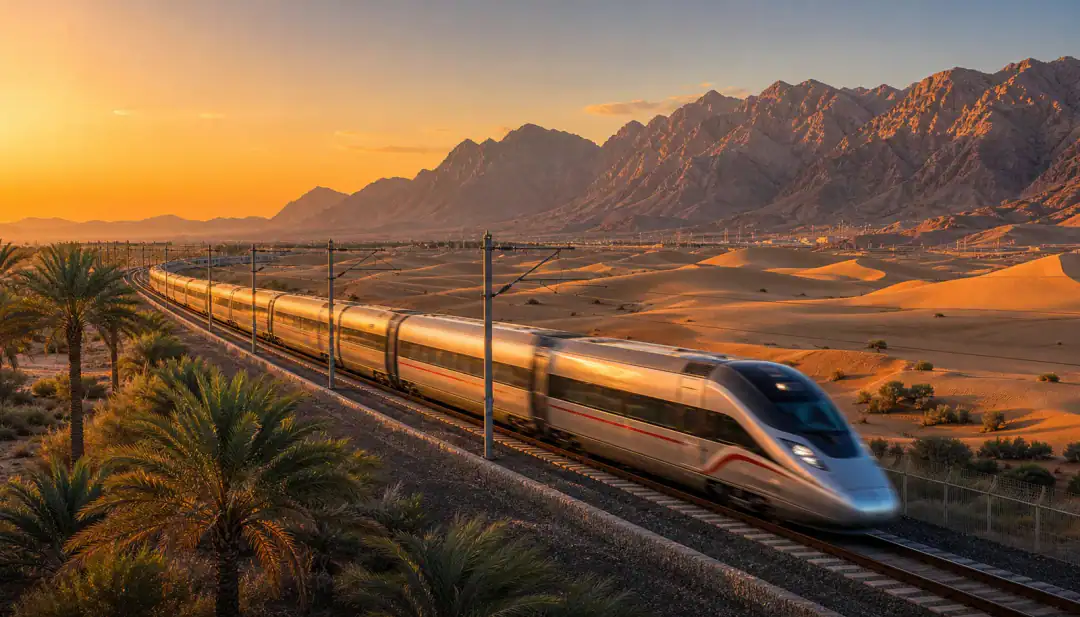
The passenger fleet consists of 13 trains built by CAF, each with capacity for up to 400 passengers and capable of speeds up to 200 km/h. Passenger services are operated by Etihad Rail Passenger Services, a joint venture between Etihad Rail and Keolis, one of the world's largest public transport operators.
Onboard, passengers can expect:
- Spacious, reclining seating with charging points for phones and laptops
- Air-conditioned coaches with large windows
- Complimentary onboard Wi-Fi on every train
- Dedicated luggage storage for larger suitcases, with overhead space for smaller bags
- Accessible restrooms and wheelchair-designated spaces
- Family-friendly seating areas, with allowances made for strollers and pushchairs Etihad Rail has also signed a contract with Italian luxury hospitality company Arsenale to develop a separate luxury train experience, expected to bring an Orient Express-style premium offering to parts of the network in future phases. Stations themselves are being built as more than transit points, with cafés, restaurants, retail outlets, and international hospitality brands planned across the network.
Get the Best Offer: Apartments for Sale in Abu Dhabi
Comfort Class vs Premium Class
Comfort Class is designed for the majority of travellers, with spacious seating, air conditioning, charging ports, and a comfortable standard environment suited to everyday intercity travel.
Premium Class offers more space and a quieter environment, suited to business travellers or anyone who wants extra room to work or relax during the journey.
Both classes include guaranteed seating and onboard Wi-Fi. The difference is primarily about space and atmosphere rather than a major gap in core amenities.
Can Tourists Use Etihad Rail?
Yes, and tourists are expected to be among the biggest beneficiaries of the new network. Previously, visitors wanting to explore multiple emirates had to either rent a car or book an organised tour. Etihad Rail introduces a third option: independent intercity travel without the unfamiliarity of driving on UAE roads.
A practical example: a visitor based in Dubai could take the train to Abu Dhabi in the morning, spend the day at the Louvre Abu Dhabi or along the Corniche, and return the same evening, all without renting a car or arranging private transport. Once the Fujairah route is fully integrated with the rest of the network, the same applies to east coast day trips combining the train with time at the beach or in the Hajar Mountains.
Visitors should carry the same identification used when booking, typically a passport, and keep it accessible during the journey since it may be requested.
Who Should Use Etihad Rail?
Residents and daily commuters living in one emirate and working in another gain a predictable, traffic-free alternative to driving, particularly valuable once the Abu Dhabi-Dubai route opens in September 2026.
Business travellers can plan same-day return trips between emirates with a fixed, reliable journey time, something road travel cannot guarantee given variable traffic.
Families benefit from more space and flexibility than a long car journey, particularly with the accommodations made for strollers and luggage.
Students studying away from home gain an easier, more affordable way to travel back for weekends or holidays.
Tourists gain the freedom to explore multiple emirates independently without needing to drive or book organised tours.
Get The Best Offer: Villas for Sale in Abu Dhabi
Etihad Rail and Last-Mile Connectivity
A common question is what happens once you arrive at a station that isn't right next to your final destination. Etihad Rail and local transport authorities are actively building this connectivity in. In Abu Dhabi, shuttle buses will run between Mohamed bin Zayed City station and key destinations including ADNOC headquarters, ADNEC, and Reem Mall. In Dubai, the RTA is developing feeder bus and taxi integration to ensure last-mile access once Jumeirah Golf Estates station opens. Stations are generally designed with dedicated taxi ranks, drop-off and pick-up zones, and parking, with the specific mix of facilities varying by station.
Get The Best Price: Townhouses for Sale in Abu Dhabi
Why Etihad Rail Matters for Property and Investment
Major rail infrastructure has historically reshaped property demand around the stations it serves, and Etihad Rail is expected to follow the same pattern. The land surrounding the new Al Hilal City station in Fujairah is already earmarked for major residential development, and similar station-area growth is likely as Mohamed bin Zayed City, Jumeirah Golf Estates, and the other confirmed stations come online through 2027. For investors and homebuyers, proximity to a confirmed Etihad Rail station is becoming a genuine factor in long-term property value, not just a convenience.
Masterpiece Property is a trusted real estate agency in Abu Dhabi that tracks exactly this kind of infrastructure development when advising clients on long-term property value. Whether you are considering a property near Mohamed bin Zayed City station or evaluating how the wider Etihad Rail rollout might affect demand across Abu Dhabi's communities, the team provides grounded, current guidance rather than speculation.
The agency covers apartments, villas, townhouses, and plots across Abu Dhabi's prime communities including Yas Island, Saadiyat Island, Al Reem Island, Al Raha Beach, Khalifa City, Masdar City, and Al Reef.
Contact Masterpiece Property today at 800 666 888 to discuss property opportunities connected to Abu Dhabi's growing transport infrastructure.
Frequently Asked Questions
When did Etihad Rail passenger service start?
The introductory phase began on 30 June 2026, connecting Abu Dhabi's Mohamed bin Zayed City station to Fujairah's Al Hilal City station. The full network's official launch follows on 30 September 2026 with the opening of the Dubai (Al Yalayis) and Al Dhaid stations.
Three trains a day in each direction. Abu Dhabi to Fujairah departs at 8:19 am, 1:53 pm and 6:39 pm; Fujairah to Abu Dhabi departs at 5:34 am, 10:59 am and 5:28 pm. Each journey takes 1 hour 45 minutes.
How much do Etihad Rail tickets cost?
On the Abu Dhabi-Fujairah route, launch fares start at AED 55 for Comfort Class and AED 120 for Premium Class, with children from AED 28, seniors from AED 44 and infants free. The regular adult fares after the launch offer are AED 109 (Comfort) and AED 239 (Premium).
How long does the Abu Dhabi to Fujairah train take?
The journey takes 1 hour and 45 minutes, compared to several hours by road depending on traffic and route.
How long will Abu Dhabi to Dubai take on Etihad Rail?
Approximately 57 minutes on the standard passenger network once Dubai's station opens on 30 September 2026. A separate high-speed line planned for 2030 will eventually cut this to 30 minutes at speeds of up to 350 km/h.
When does the Etihad Rail Dubai station open?
Dubai's Al Yalayis station, near Jumeirah Golf Estates, opens on 30 September 2026 together with Al Dhaid station in Sharjah. Fares and timings for Dubai will be announced by Etihad Rail before that date.
Is parking free at Etihad Rail stations?
Yes. Parking at the Abu Dhabi station is free for ticket holders, and a Hafilat shuttle bus for AED 10 connects the station with Reem Mall, ADNOC headquarters and ADNEC.
Where can I buy Etihad Rail tickets?
Through the official Etihad Rail website, the Etihad Rail mobile app (available on Google Play and the App Store), or at ticket counters and self-service kiosks at selected stations. Booking opened on 23 June 2026.
How many stations does the Etihad Rail passenger network have?
11 confirmed stations across the initial rollout: Mohamed bin Zayed City, Al Hilal City (Fujairah), Jumeirah Golf Estates (Dubai), Al Dhaid (Sharjah), University City (Sharjah), and the Al Dhafra region stations of Al Sila, Al Dhannah, Al Mirfa, Madinat Zayed, and Liwa/Mezaira'a.
How fast do Etihad Rail trains go?
The standard passenger fleet reaches speeds of up to 200 km/h. A separate future high-speed line between Abu Dhabi and Dubai is designed for speeds up to 350 km/h.
Can tourists use Etihad Rail without a UAE residency or driving licence?
Yes. Tourists can book and travel using a passport for identification, with no UAE residency or driving licence required.
Can I bring luggage on Etihad Rail?
Yes. Smaller bags fit in overhead compartments, and dedicated space is provided for larger suitcases, similar to long-distance coach or domestic flight allowances.
Is Etihad Rail connected to Abu Dhabi and Dubai airports?
Direct airport connections are not yet confirmed for the initial launch stations, though last-mile connectivity through shuttle buses, taxis, and integration with local transport authorities is actively being developed as the network expands.
Who operates Etihad Rail passenger services?
Etihad Rail Passenger Services, a joint venture between Etihad Rail and Keolis, one of the world's leading public transport operators, runs the passenger network day to day.