Economics
| Factor | Details |
|---|
| Entry cost | 10-20% of purchase price (deposit instalments) |
| Hold period | 6-24 months |
| Target profit | 15-30% above purchase price |
| Assignment fee | 2-5% of purchase price (developer charges) |
| Registration | May require Oqood/interim registration |
| Best timing | Buy at launch, sell as construction progresses |
Example
| Step | Amount |
|---|
| Off-plan purchase price | AED 1,200,000 |
| Deposit paid (20%) | AED 240,000 |
| Construction instalments paid | AED 120,000 |
| Total cash invested | AED 360,000 |
| Sale price (18 months later, +20%) | AED 1,440,000 |
| Assignment fee (3%) | -AED 36,000 |
| Net profit | AED 204,000 |
| ROI on cash invested | 56.7% |
| Annualized ROI | 37.8% |
2. Ready Property Quick Flip
How it works:Purchase completed property below market value (distressed sale, motivated seller, off-market deal), then sell at market value.
Economics
| Factor | Detail |
|---|
| Entry cost | Full purchase price or 25% down + mortgage |
| Hold period | 3-12 months |
| Target discount | 10-20% below market |
| Exit at | Market value |
| Transaction costs | ~6-8% (registration, agents, mortgage costs) |
Example
| Step | Amount |
|---|
| Market value | AED 1,500,000 |
| Purchase price (12% below market) | AED 1,320,000 |
| Registration fee (2%) | AED 26,400 |
| Total cost | AED 1,346,400 |
| Sale at market value | AED 1,500,000 |
| Registration fee (buyer pays) | AED 0 |
| Net profit | AED 153,600 |
| Hold period | 6 months |
| ROI (if 25% down + mortgage) | 46.5% |
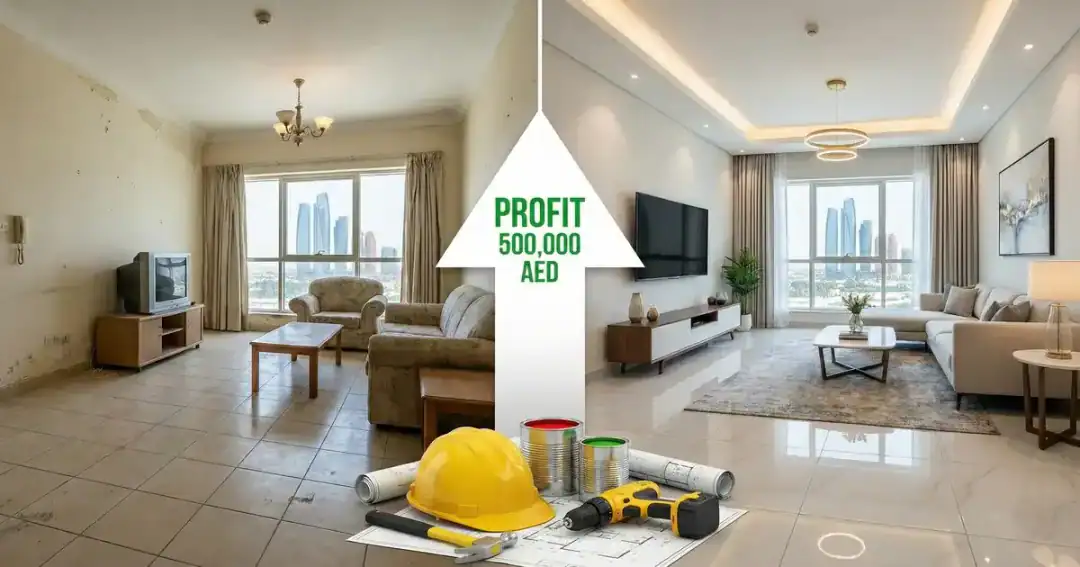
3. Renovation Flip (Value-Add)
How it works:Purchase older property in prime location, renovate to modern standards, sell at renovated market value.
Economics
| Factor | Detail |
|---|
| Target properties | 10-20 year old units in established areas |
| Renovation budget | 10-20% of purchase price |
| Hold period | 3-9 months (renovation + sale) |
| Value uplift | 20-35% above un-renovated price |
| Best areas | Al Reem Island older towers, Corniche apartments |
Example
| Step | Amount |
|---|
| Purchase price (older 2-bed, Al Reem) | AED 900,000 |
| Registration fee (2%) | AED 18,000 |
| Renovation cost | AED 120,000 |
| Holding costs (6 months) | AED 15,000 |
| Total investment | AED 1,053,000 |
| Sale price (renovated market value) | AED 1,250,000 |
| Net profit | AED 197,000 |
| ROI | 18.7% (6-month period) |
| Annualized ROI | 37.4% |
4. Land Flipping
How it works:Purchase land plots in areas with upcoming development approval, hold through zoning/planning progress, sell to developers or end-users at premium.
Economics
| Factor | Detail |
|---|
| Entry cost | Full payment (mortgages rare for land) |
| Hold period | 1-5 years |
| Target appreciation | 30-100%+ |
| Risk level | High (regulatory, timing, demand) |
| Best areas | Emerging communities with confirmed masterplans |
Market Conditions Favouring Flipping (2026)
Current Positive Indicators
| Indicator | Status | Flip Impact |
|---|
| Price trend | Rising 5-8% annually | Positive (appreciation during hold) |
| Off-plan demand | Strong (66% of transactions) | Positive (assignment opportunities) |
| International buyer influx | Growing 35%+ | Positive (exit buyers available) |
| Developer launches | Multiple major projects | Positive (launch pricing below market) |
| Transaction volume | 39,000+ deals annually | Positive (liquidity for exit) |
Warning Indicators to Monitor
| Indicator | Risk Signal | Action |
|---|
| Transaction volume decline | 15%+ drop quarter-over-quarter | Reduce new purchases |
| Supply surge | Major handovers in target area | Avoid that micro-market |
| Price stagnation | 2+ quarters of flat prices | Pause flipping activity |
| Interest rate increases | 100+ basis point rise | Reduce leveraged flips |
| Regulatory changes | New assignment restrictions | Adjust strategy |
Cost Analysis: Break-Even Calculator
Minimum Appreciation Required to Break Even
| Cost Item | Percentage of Property Value |
|---|
| Registration fee (purchase) | 2.0% |
| Developer assignment fee (off-plan) | 2-5% |
| Mortgage costs (if applicable) | 0.5-1.5% |
| Holding costs (service charges, maintenance) | 0.5-2% |
| Total transaction cost | 5-10.5% |
Key insight: A property must appreciate at least 5-10.5% before a flipper makes any profit. In a market appreciating 5-8% annually, this means minimum 1-2 year hold periods just to break even, unless purchasing below market value.
Developer Assignment Rules
Major Developer Policies (2026)
| Developer | Assignment Allowed? | Fee | Minimum Holding | Conditions |
|---|
| Aldar | Yes (with approval) | 2-3% | After 40% paid | NOC required |
| Modon | Yes (conditions apply) | 3-5% | After 50% paid | Case by case |
| Bloom | Limited | 3% | After 40% paid | Developer approval |
| IMKAN | Restricted | Varies | After 50% paid | Project specific |
| Reportage | Yes | 2-3% | After 30% paid | NOC required |
Important: Developer assignment policies change frequently. Always verify current policy before purchasing with flip intent.
Risk Management Framework
Risk Categories
1. Market Risk (Price Decline)- Probability (2026): Low-Medium (market in growth phase)
- Impact: Moderate-High (forced to hold or sell at loss)
- Mitigation: Buy at genuine discount, maintain cash reserves, set stop-loss exit point
2. Liquidity Risk (Can't Sell)- Probability: Medium (depends on micro-market)
- Impact: High (stuck holding with carrying costs)
- Mitigation: Target liquid unit types (1-bed, 2-bed), popular communities, competitive pricing
3. Regulatory Risk (Rules Change)- Probability: Low-Medium
- Impact: Medium-High (assignment restrictions, new fees)
- Mitigation: Stay informed, maintain flexibility, diversify across developers
4. Renovation Risk (Cost Overrun)- Probability: Medium-High (common in renovation projects)
- Impact: Medium (reduced profit margin)
- Mitigation: Detailed contractor quotes, 20% contingency budget, fixed-price contracts
5. Financing Risk (Mortgage Issues)- Probability: Low-Medium
- Impact: High (unable to complete purchase or forced sale)
- Mitigation: Pre-approval before purchase, cash reserves, flexible financing
The 30% Rule
Never commit more than 30% of liquid net worth to active flipping positions. This ensures:
- Cash reserves for unexpected costs or holding periods
- Ability to absorb one failed flip without financial distress
- Flexibility to capitalise on new opportunities
- Peace of mind enabling rational decision-making
Tax and Regulatory Considerations
Transaction Costs Summary
| Cost | Who Pays | Amount |
|---|
| ADREC registration (2%) | Buyer (typically) | 2% of property value |
| NOC fee | Seller | AED 500-5,000 |
| Mortgage registration | Buyer | 0.25% of mortgage |
| Mortgage discharge | Seller | AED 1,000-3,000 |
| Valuation fee | Buyer | AED 2,500-3,500 |
| Developer assignment fee | Seller/Assignor | 2-5% |
Capital Gains Tax
UAE: 0%: No capital gains tax on property sales for individuals
This is the single biggest advantage for property flippers in the UAE. In most developed markets, short-term capital gains are taxed at 20-45%, which would eliminate most flipping profits. The UAE's zero-tax environment makes strategies viable that would be marginal elsewhere.
Who Should (and Shouldn't) Flip Properties
Good Candidates for Flipping
| Characteristic | Why It Matters |
|---|
| Available capital (AED 300K+) | Can absorb holding costs and delays |
| Market knowledge | Identifies genuine below-market opportunities |
| Risk tolerance | Comfortable with potential losses |
| Time availability | Can monitor market and manage transactions |
| Local network | Access to off-market deals, reliable contractors |
| Experience | Has completed at least 1-2 property transactions |
Poor Candidates for Flipping
| Characteristic | Why It's Risky |
|---|
| First-time investor | Lacks market knowledge for timing |
| Limited capital | Can't absorb unexpected costs or delays |
| Risk averse | Flipping requires tolerance for uncertainty |
| No local presence | Difficult to manage renovations remotely |
| Emotional decision-maker | May hold too long or panic sell |
Flipping vs Buy-and-Hold: When Each Wins
| Scenario | Flipping Wins | Buy-and-Hold Wins |
|---|
| Rising market (5%+ annually) | Quick profits on momentum | Long-term compounding |
| Flat market | Only renovation flips viable | Rental income covers costs |
| Declining market | Avoid entirely | Hold through cycle |
| High transaction costs | Only if margins > 15% | Amortized over years |
| Available financing | Quick equity recycling | Leverage amplification |
| Tax-free environment (UAE) | Full profit retained | Full income retained |
| Optimal approach | Active, capital-intensive | Passive, time-intensive |
Conclusion
Property flipping in Abu Dhabi's 2026 market offers compelling return potential, 15-40% on invested capital within 6-24 month timeframes, but demands discipline, market knowledge, and robust risk management. The UAE's zero capital gains tax environment makes strategies viable that would be marginal in taxed jurisdictions, while strong market momentum and international buyer demand provide exit liquidity.
Key Takeaways
- Off-plan assignments: 30-50% ROI potential on 10-20% capital deployed
- Renovation flips: 30%+ annualized returns in prime locations
- Break-even threshold: 5-10.5% appreciation needed before profit
- Zero capital gains tax: Full profit retained (UAE advantage)
- 30% rule: Never commit more than 30% of liquid wealth to flips
- Market timing: Current rising market favours flipping, monitor for shifts
- Developer policies: Verify assignment rules before purchasing off-plan
Property flipping is not passive income, it is active investment that rewards preparation, discipline, and market expertise. For qualified investors who understand the risks, Abu Dhabi's current market cycle offers a favourable environment for strategic flipping alongside a core buy-and-hold portfolio.
If you plan to sell within a short period, Masterpiece Property's team can tell you the developer's assignment rules for a specific project and what similar units have resold for; see our selling page when the time comes.
Sources & References
- Abu Dhabi Real Estate Transaction Data
- Off-Plan Property Assignment Rules
- Abu Dhabi Property Market Analysis 2026
- Property Renovation ROI Guide
- ADREC Registration and Fees
- UAE Capital Gains Tax Status