
Blockchain in Real Estate: How Smart Contracts Are Changing Property Transactions
9 min read
About Masterpiece Property
Masterpiece Property LLC is a real estate brokerage licensed by the Abu Dhabi Real Estate Centre (ADREC), profession licence 20250000451516, trade licence CN-5713917, with two offices in Al Zahiyah, Abu Dhabi.
Our ADREC licensed brokers help buyers and sellers with ready and off-plan homes on Saadiyat, Yas, Al Reem and Hudayriyat Islands, in English and Arabic. Call 800 666 888.
1. Digital Land Registry
Current Status:Abu Dhabi Real Estate Centre (ADREC) has progressively digitized property registration, with blockchain integration enhancing security and accessibility.
Benefits
| Feature | Traditional Registry | Blockchain Registry |
|---|---|---|
| Title verification | 3-5 business days | Instant |
| Fraud risk | Moderate (forgery possible) | Near zero (immutable record) |
| Access | Office visits required | Online 24/7 |
| Cost | AED 3,000-5,000 per search | AED 200-500 |
| Historical records | Paper archives | Complete digital history |
| Cross-reference | Manual check | Automated |
2. Smart Contract Escrow
How it works
- Buyer deposits purchase funds into smart contract address
- Smart contract holds funds until all conditions are verified
- Conditions: title clear, NOC obtained, inspection passed, mortgage approved
- When all conditions met, funds automatically transfer to seller
- Ownership simultaneously updates on blockchain registry
Cost savings
- Eliminates traditional escrow charges (1-2% of transaction)
- Reduces legal costs by 30-50% through standardized contracts
- Faster settlement reduces financing holding costs
- On AED 2M property: saves AED 25,000-40,000 in transaction costs
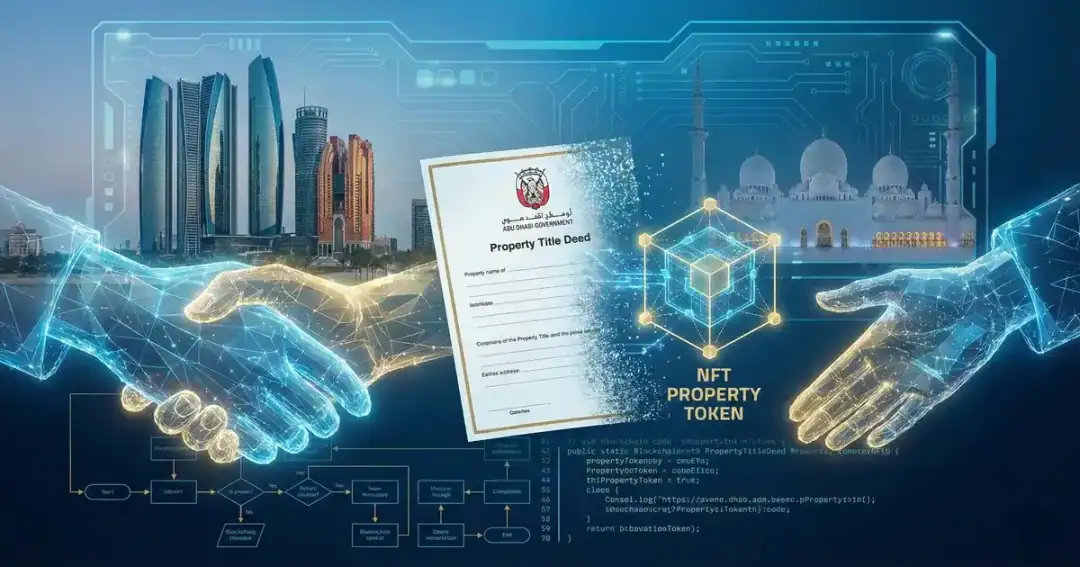
3. Property Title Tokenization
Converting property titles into blockchain-based digital tokens enables:
- Instant verification of ownership
- Fractional ownership through token division
- Cross-border transfer without physical documents
- Automated inheritance distribution per smart contract terms
- Lien and mortgage recording on same blockchain
4. Rental Agreement Automation
Smart contracts managing rental relationships:
- Automatic rent collection on due dates
- Late payment penalties calculated and applied automatically
- Security deposit held in smart contract, released on conditions
- Maintenance request tracking with contractor payments
- Lease renewal or termination triggered by predefined events
Impact
- 90% reduction in rent collection disputes
- 60% faster security deposit returns
- 40% lower property management administrative costs
5. Supply Chain Transparency for Construction
Blockchain tracking construction materials and processes:
- Material provenance verification (origin, quality, certification)
- Progress milestone payment automation
- Contractor compliance and insurance verification
- Building inspection record immutability
- Warranty tracking and enforcement
UAE Blockchain Strategy
Government Initiatives
UAE Blockchain Strategy 2021
- 50% of government transactions on blockchain by target date
- Real estate identified as priority implementation sector
- Federal and emirate-level coordination
- International partnerships with leading blockchain companies
Abu Dhabi Digital Authority
- Digital government services integration with blockchain
- Cross-department data sharing through distributed ledger
- Citizen identity verification for property transactions
- Integration with Emirates ID and digital wallet systems
ADGM Regulatory Framework
- Licensed blockchain service providers operating in Abu Dhabi
- Clear regulatory environment for digital assets
- Sandbox programmes for blockchain real estate startups
- English common law jurisdiction providing international legal certainty
Adoption Timeline
| Phase | Period | Milestone |
|---|---|---|
| Foundation | 2017-2020 | First blockchain land registry transactions |
| Pilot | 2020-2023 | Government pilot programmes, regulatory frameworks |
| Expansion | 2023-2025 | Commercial platform launches, developer adoption |
| Integration | 2025-2027 | Cross-system integration, mainstream adoption |
| Maturity | 2027-2030 | Standard practice, international interoperability |
Cost and Time Savings Analysis
Transaction Cost Comparison
Sale of AED 3,000,000 property
| Cost Item | Traditional | Blockchain-Enabled | Savings |
|---|---|---|---|
| Registration fee (2%) | AED 60,000 | AED 60,000 | 0% (government fee) |
| Legal fees | AED 15,000-25,000 | AED 5,000-10,000 | 50-60% |
| Escrow fees | AED 10,000-15,000 | AED 2,000-3,000 | 75-80% |
| Title search | AED 3,000-5,000 | AED 500-1,000 | 80% |
| Bank processing | AED 5,000-8,000 | AED 2,000-3,000 | 50-60% |
| Total fees (excl. registration) | AED 33,000-53,000 | AED 9,500-17,000 | 68-71% |
Time Savings
| Process Step | Traditional | Blockchain | Reduction |
|---|---|---|---|
| Title verification | 3-5 days | Instant | 100% |
| Due diligence | 2-4 weeks | 2-3 days | 80-90% |
| Contract preparation | 1-2 weeks | 1-2 days | 85% |
| Escrow and payment | 1-2 weeks | 1-2 days | 85% |
| Registration | 3-7 days | Same day | 70-85% |
| Total process | 6-12 weeks | 1-2 weeks | 75-85% |
Smart Contract Use Cases
Use Case 1: Off-Plan Purchase with Milestone Payments
Scenario: Buyer purchases off-plan apartment for AED 2,000,000 with construction milestone payments.Smart Contract Logic:If construction_milestone_1_verified = TRUE → Release AED 200,000 to developerIf construction_milestone_2_verified = TRUE → Release AED 300,000 to developer
If construction_milestone_3_verified = TRUE → Release AED 300,000 to developer
If handover_inspection_passed = TRUE → Release AED 200,000 to developer
If 12_month_defect_period_clear = TRUE → Release AED 1,000,000 to developer
Benefits
- Buyer protected: funds only released on verified construction progress
- Developer incentivized: automatic payment on milestone completion
- Dispute reduction: objective verification replaces subjective assessment
- Transparency: both parties see same progress data
Use Case 2: Rental Income Distribution
Scenario: Tokenized property with 1,000 token holders receiving monthly rental income.Smart Contract Logic:Monthly_rent_received = AED 8,000Management_fee (10%) = AED 800
Distributable_amount = AED 7,200
Per_token_distribution = AED 7.20
Execute: distribute AED 7.20 to each of 1,000 token wallets
Benefits
- Automated distribution to thousands of holders simultaneously
- Transparent calculation visible to all token holders
- No manual processing errors
- Real-time distribution vs quarterly traditional method
Use Case 3: Automated Lease Management
Scenario: Commercial lease with escalation clauses and performance conditions.Smart Contract Logic:Base_rent = AED 200,000/yearAnnual_escalation = 5%
If CPI_increase > 3% → Apply additional CPI adjustment
If tenant_revenue > AED 5,000,000 → Apply 2% revenue share
If late_payment > 30_days → Trigger default notice
If lease_expiry < 180_days → Send renewal notification
Benefits
- Automatic rent escalation calculation and invoicing
- Revenue-share triggers based on verified data
- Early warning systems for defaults
- Renewal management without manual intervention
Challenges and Limitations
Technical Challenges
| Challenge | Current Status | Expected Resolution |
|---|---|---|
| Scalability | Blockchain can be slow for high-volume transactions | Layer-2 solutions, newer blockchains (2026-2027) |
| Interoperability | Different blockchains don't communicate easily | Cross-chain bridges being developed (2027-2028) |
| Data privacy | Blockchain transparency conflicts with privacy | Zero-knowledge proofs enabling private transactions |
| Energy consumption | Some blockchains are energy-intensive | Move to proof-of-stake (largely complete) |
| User interface | Complex for non-technical users | Improving rapidly with consumer-facing apps |
Legal Challenges
| Challenge | Impact | Mitigation |
|---|---|---|
| Legal recognition of smart contracts | Not universally recognized as binding | UAE advancing legislation, ADGM framework |
| Dispute resolution | Smart contracts execute automatically | Incorporating arbitration clauses, kill switches |
| Cross-border enforcement | Different jurisdictions, different rules | International cooperation agreements |
| Code bugs | Smart contract errors could cause financial loss | Professional auditing, insurance products |
| Regulatory evolution | Rules may change as technology develops | Flexible platform architecture |
Market Adoption Barriers
| Barrier | Impact Level | Timeline to Resolution |
|---|---|---|
| Industry inertia | High: traditional processes deeply embedded | 3-5 years for mainstream shift |
| Professional resistance | Medium: agents, lawyers face disruption | Evolving role rather than elimination |
| Technology literacy | Medium: stakeholders need education | 2-3 years as tools simplify |
| Infrastructure cost | Medium: initial setup investment | Declining rapidly as adoption grows |
| Trust in technology | Medium: prefer known processes | Growing with successful transactions |
Investment Implications
How Blockchain Affects Property Investment
1. Lower Transaction Costs = Higher Net Returns- Lower transaction fees (excluding the registration fee)
- On AED 3M property: AED 23,500-36,000 savings
- Improves buy-hold-sell economics for active investors
- 75-85% faster transaction completion
- Enables better market timing (buy dips, sell peaks)
- Reduces financing holding costs during settlement
- Complete ownership history visible on blockchain
- Reduces title fraud risk (significant in emerging markets)
- Verifiable property data supports better decision-making
- Fractional ownership enabling portfolio diversification
- Liquidity through secondary token trading
- Automated income distribution via smart contracts
Properties Best Suited for Blockchain Integration
| Property Type | Blockchain Benefit | Adoption Level |
|---|---|---|
| Commercial (multi-tenant) | Automated rent collection, tokenization | High |
| Off-plan residential | Milestone payment protection | Medium-High |
| Residential (rental) | Lease automation, deposit management | Medium |
| Luxury/premium | Provenance and ownership verification | Medium |
| Fractional/tokenized | Core infrastructure requirement | Very High |
Conclusion
Blockchain technology is progressively transforming Abu Dhabi's real estate sector from a paper-heavy, intermediary-dependent process into a streamlined, transparent, and automated ecosystem. Smart contracts are cutting transaction fees, reducing settlement times by 75-85%, and enabling new investment models through tokenization and fractional ownership.
Key Takeaways
- Cost reduction: lower transaction fees through smart contracts
- Speed: 75-85% faster transaction completion (weeks to days)
- Security: Immutable blockchain registry eliminates title fraud
- Automation: Smart contracts manage escrow, payments, leases automatically
- UAE leadership: Government strategy targeting 50% blockchain transactions
- ADGM framework: Clear regulatory environment for blockchain real estate
- Growing adoption: All major developers and government entities progressing toward blockchain integration
The transition to blockchain-enabled real estate is not a question of if, but when. For investors and buyers in Abu Dhabi, understanding and embracing blockchain technology provides a competitive advantage in transaction efficiency, cost savings, and access to emerging investment models.
Masterpiece Property's transactions still complete today through ADREC's registration and the DARI platform, and our agents walk buyers through each digital step as the emirate adds new ones.
Sources & References
Disclaimer: Content is for informational purposes only and does not constitute real estate, legal, or financial advice. Property details, prices, and market data are subject to change. Always seek professional guidance before making any property decision.

Free consultation
Need help choosing the right Abu Dhabi property?
Share your details and our team will connect this article to live projects, availability, payment plans, and suitable investment options.
AvailabilityPayment plansInvestment fit
800 666 888Related Projects
Explore matching off-plan opportunities
Curated projects connected to this topic, with current launches and investment-ready options.
 Handover 2028STELLAR by ELIE SAAB at Yas BayYas IslandBy Emirates DevelopmentsFrom AED 2,200,000View project
 Handover Q4 2028Hilton Residences Abu Dhabi Al RahaAl Raha BeachBy Emirates DevelopmentsFrom AED 2,500,000View project
 Handover 2031Jumeirah Residences Al Maryah IslandAl Maryah IslandBy Emirates DevelopmentsPrice on requestView project